one life to Live

In January, I had the flu. . . . . . . . . . . . . . . . . . . . . . . . . . . . . . . . . . . . . . . . . . . . . . .
IMG_2200

Not much of a news flash, I realize, but I was unable to stay hydrated and I failed to keep my sugar under 250. The end result was two visits to the Emergency Room in one day with a diagnosis of DKA and Influenza.

I never felt exceptionally sick from the flu. The first night in the intensive care unit was the worst because my nose was clogged and I hate not being able to breathe freely. Worse than blocked air passages, though, is vomiting. At least, for me it is. I HATE nausea. I hate feeling like I’m going to throw up and I hate the act of vomiting. I bring this up only because my story today revolves around the four times in my life when nausea has truly been an issue for me. It is rare for me to have issues with my stomach being unhappy. I am generally an exceptionally healthy individual–except for my broken pancreas. And that is the common thread among ALL four of my most horrendous encounters with nausea.

The first time was in early 2000 while I visited my parents in Bremerton, Washington. We had pizza for dinner and, sometime in the middle of the night, I woke up and started vomiting. And I didn’t stop. Even after the only thing coming up was sickish-green looking bile. By this time I had made it down the hall to wake up my parents, which was awkward only because I was 25 and of the belief I shouldn’t have to wake up my mommy to take care of me. Only I needed her that night. I distinctly remember one moment kneeling  over the toilet bowl and my mom lovingly asking me if I wanted any left-over pizza. (I know when you read this, mom, that you will feel guilty–but DON’T!!) This memory still makes me cringe and grin simultaneously.

I spent the next few days not able to get out of bed except to limp into the bathroom to take a hot shower in the hopes of relieving the extreme pain in my lower back. The showers never helped me though, because, as I know now, the pain was in my kidneys and had nothing to do with my muscles. In retrospect, I can look back to this episode and realize it was an attack of acute pancreatitis that should have put me in a hospital bed–if I weren’t such a strong and stubborn individual. The question has now, in the intervening years, become like the question of the chicken or the egg: Could it have been my undiagnosed diabetes causing the pancreatitis, or did the pancreatitis create my diabetes?

The answer doesn’t matter. What does matter is the fact that my next encounter with nausea was in 2008 while I was living in Las Vegas and was diagnosed with insulin-dependent diabetes. I shared that particular horror in a past post and have no desire to embellish again. Suffice it to say that being 25 before my first encounter with nausea, and the fact that it was eight years before the next encounter, goes far in proving my point that nausea and I do not share a close relationship–diabetes links us despite my general imperviousness for nausea.

My third encounter was approximately five years later while I was living in Eugene without health insurance. I was buying my insulin (Regular/NPH) over the counter, along with my syringes and strips. This regime had sustained me through my first year after diagnosis in Vegas and during the first few years of residing in Eugene. At the time, living without a diabetic support team, and having experienced debilitating hypoglycemic events, I felt compelled to maintain my sugar around 200. Eventually, this led to my second experience with, but first diagnosis of, Diabetic Ketoacidosis. The day started with my decision to ride the long way to work so I could stop at McDonald’s and get a couple egg mcmuffins to start the day with. I made it to Mickey D’s, but I had to call in sick to work while in the parking lot because the nausea had become so intense. I went home, started throwing up, and finally called a friend to take me to the hospital.

I was in the hospital for four days. I started on Lantus and Humalog, was enrolled with State-covered health insurance, and started visiting an endocrinologist regularly again. I may have recovered from the severe consequences of high blood sugar, but I was once again a victim of the severe side-effects of insulin. After a couple of years, I finally made the decision to switch to pump therapy in the hopes of relieving the hypoglycemia. My journey of making the transition from syringe to pump is a story I’m saving for another day (but one well worth the telling).

My fourth, and currently final, encounter with nausea was in January of this year. I was sick with the flu and I did what I was supposed to do: stayed home and rested while trying to stay hydrated. But it didn’t work. I kept throwing up after drinking water or Gatorade. I finally decided at three in the morning to call a taxi to take me to the hospital. The waiting room was quiet and the wait wasn’t long. I was eventually sent home by 6:30 with the instructions to stay hydrated. I had gone in telling them that my sugar wouldn’t go below 250 no matter how much insulin I added (and how that worried me because it is ALWAYS terrifying to stack insulin knowing it will most likely ALL kick in at the exact same moment–and THEN start to finally work within a five minute time frame). But the doctor simply said, “you do have some ketones in your blood, but just stay hydrated.”

So I went home and tried to stay hydrated. My stacked insulin never kicked in and my blood sugar stayed high. I finally called a friend at 6pm to take me back to the hospital. This time the waiting room was packed. I sat and waited until almost 9:00 before finally being admitted. I had started vomiting again around 7:45 and spent the last hour of my wait sitting in the corner with a vomit bag slowly filling up while I cried on the phone with my mom wishing someone would come and help me. By midnight I was diagnosed with Influenza (again) with complications of non-coma Diabetic Ketoacidosis (the exact reason why I had been in the exact same hospital twenty hours earlier with the hopes of avoiding).

They needed to put me in intensive care, the only problem being that there wasn’t an available bed anywhere in the valley: Eugene/Springfield, Albany and Salem were full of Influenza patients. I was told at midnight that I would be transported by ambulance to Oregon Health Sciences in Portland. I said OK and went back to sleep. I was awoken at 1:30 and told that my diagnosis had put me on the top of the transport list and I would be flown to Portland. I said OK and signed the paperwork they handed me. By 2:30 I was wrapped to a gurney and transported, in my first ambulance ride, to the Eugene airport and put on a private jet. There was just enough room for my gurney, my two medics, and the pilot. I admit to being disappointed it wasn’t a helicopter, but a private jet ride still ain’t too shabby.

By 5:00 I was tucked away in the medical intensive care unit at OHSU and feeling just fine, now that my sugar had finally been brought back down into range long enough to give nausea-theunwelcomehouseguest a welcome kick in the arse. I spent a total of three days in the hospital, which was asinine and a direct factor of the complete incompetence of some medical professionals to comprehend diabetes, let alone how to efficiently treat it without the benefit of listening to the person who experiences living with her diabetes EVERY SINGLE DAY (again, another story for another day).

I don’t know if I would experience nausea in my life to the extent that I do if I were to have a functioning pancreas. What I do know is that I appreciate nausea for always being a sincere and accurate indicator of severe problems associated with my dysfunctional pancreas. I despise nausea, but I respect it enough to always listen and pay attention. The parameters of my life were dropped on me without the benefit of options. Sometimes, I am so jealous of the Type 2’s who are able to reverse the effects of diabetes with exercise and lifestyle changes. I wish I could simply make a change in my life that would have the effect of minimizing my experience with diabetes, but all the changes I am forced to make are changes necessary for my ability to survive the process of using the only substance known to keep me alive.

At times it feels incredibly unfair. At other times it feels completely natural. After all, this life is the only Life I have to live.
How Low Can YOU Go?

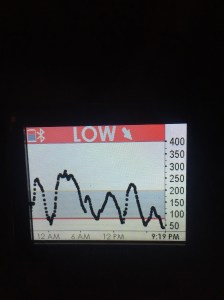
Low blood sugars can be scary. They certainly scare the hell out of me when I’m alone. A few weeks ago, I was walking to the store when I realized I was no longer walking in a straight line. My blood sugars had begun to drop so suddenly that my cgm was unable to keep up and give me a warning. By the time I made it to the street the store was on I could feel my thigh muscles begin to twitch–a sign that a seizure is close at hand. I had one applesauce packet with me in my purse and I swayed on the street corner sucking it down, praying I would make it through the parking lot without collapsing. There weren’t many cars out, but I stood on that corner for a few minutes staring at the one way street I wanted to cross, the one way cross-street with oncoming traffic, and the street lights trying to convince myself that it was safe to step out into the street and not get hit by a car. I was scared that I would be confused and step in front of a moving car by mistake. I had to chuckle, though, at the image of me standing on the corner, swaying like a drunk, and all the people in their cars hoping I wasn’t too drunk to step out in front of them suddenly.

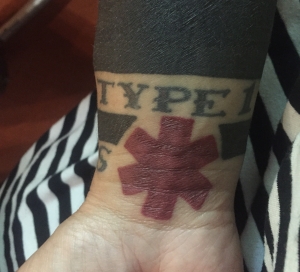
I finally made it into the store and went straight to the bakery section. I knew where I was at the time, but I was unable to recognize my surroundings. Thankfully, I shop at that store often and I was able to subconsciously find my way to accessible carbohydrates. There was one chocolate donut in the bakery case and I reached in and put it in my mouth without pausing. I was into my second bite when I looked up and saw a young woman behind the counter staring at me with a look on her face. She asked if I needed help and I simply shook my head as I went for a third chunk of chocolate donut to stuff in my mouth. I thought about twisting my arm so she could see the med alert tattoo I have on the inside of my right wrist, but, even in the midst of confusion from a bad low, I knew it was useless to try and explain WHY I needed to eat that donut as if my life depended on it.

It has been years since I’ve had a low bad enough to incapacitate me, or cause me to be unable to administer a correction without assistance. Most of the time, I hate sharing these stories because I hate how they make the non-pancreatically challenged people around me react. Either I am bombarded with suggestions on what to do to take care of myself, or with suggestions on how to prevent it from happening again–all of which are useless because they come from people who have never had to count a single carb in their entire life. Friends, family, strangers on the street…it doesn’t matter who it is, I hate being told what I should be doing by people who are not diabetic.

So I joined some online diabetic communities thinking I would be able to connect with people who could easily understand what I am experiencing. Unfortunately, it isn’t that easy, even in the virtual world.

I joined the Latent Autoimmune Diabetes in Adults community on Facebook thinking I had finally found the population of diabetics who would understand me and my particular circumstances; not adults who had grown up fighting diabetes, and not parents of children who are fighting diabetes, but other adults who had to wake up one morning and start living their adult life as a diabetic. I thought the fact that people seemed to post questions and comments meant that I had found a way to connect with people who shared a compatible need for connection and communication. Instead, I found a community of people who seemed to whine as much as type 2’s: When will I have to start taking insulin? How do I prolong my honeymoon? What should I eat to not have to take insulin? 

None of these questions concern me or my experience with diabetes. I was completely dependent upon insulin from the first moment I learned I was diabetic. My pancreas and I never had a honeymoon. I never had the option of eating anything that wouldn’t raise my blood sugars. Hundreds of diabetics from across the planet are able to connect with each other and share the experience of trying to avoid taking insulin with their food. I wish I could be one of them, but I never will be.

IMG_2573
24-hour graph with peaks and valleys, but all within a decent range

I posted one question to the community in search of other brittle diabetics like myself with a picture of my 24-hour graph showing extreme peaks and valleys in my glucose levels. I had a few people suggest I eat less carbs (without asking, of course, what my normal routine of low-carb cooking was) or suggest that I not eat so many carbs for a correction (not knowing that a 21g granola bar has the ability to send me from a 52 to 257 in less than thirty minutes). Again, I was simply receiving advice from people who are clueless, only this time they also have a malfunctioning pancreas–only their pancreas still works well enough to allow them the hope of thinking they may not need to become dependent upon insulin before the cure is found.

I didn’t get very many responses, and none of them truly helped to make me feel connected, but I did have one very interesting exchange. One woman had posted a picture of her 24-hour graph stating she “wasn’t very happy” with it: a long steady line that had a small bump going up to 175 and coming back down. My peaks had easily reached upwards of 350 and my valleys were down in the 50’s, so when I read her comment I wanted to smack her through the internet and hopefully knock some sense into her. Instead, I tried to be courteous by replying, “Damn! That looks good to me. I’m jealous!” Another women commented a few hours later berating the first woman for being so insensitive as to complain about her graph. I thought, “Finally! A chance to start a conversation!” but, before I could respond, the entire conversation thread was deleted. Great. So, not only am I still not connecting with people who are able to share similar experiences, but now some invisible and disconnected individual is censoring my post and disallowing me the opportunity to engage in a meaningful conversation that, at the very least, has the potential of increasing other people’s awareness and perceptions about diabetes.


I have finally come to accept that there is most likely not another diabetic in the world who can easily comprehend or share in the particularities of my personal brand of diabetes. As much as the memes try to remind me that I am not alone, I nevertheless feel very lonely in a world where my experiences are incomprehensible to everyone else. For example, last night I went out for dinner and drinks with a good friend and I slightly overestimated my carb count for the calamari.

IMG_2564
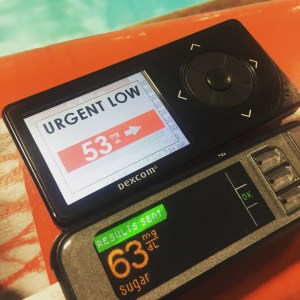
First glucose test 

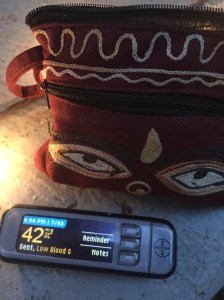
By nine o’clock my cgm started vibrating and beeping while we sat next to the fire in my yard. I was at 42 and felt perfectly fine. I started counting backwards from 100 by three’s and didn’t miss a beat. I told my friend I should maybe count back by four’s since I’m used to testing my coherency with three’s–I still did not have a problem doing the math. I started ranting about how frustrating it is to be so damn low and not feel a single symptom to give me a warning. I went inside and pulled out my stash of emergency carbohydrates: applesauce and dried fruit. I wasn’t the slightest bit hungry since I had eaten a full meal earlier at the restaurant but I drained the applesauce packet while ranting about the need to eat when I’m not hungry, and the fact that I have to waste so much garbage by using single serving pouches to accurately control my carbohydrate intake. This is not how I want to live my life, but what choice do I have if I want to stay alive??

IMG_2592
Two hours after the first glucose test, 17g of applesauce, and no basal (I usually keep my temp basal for an hour at a time)

My blood sugar slowly rose up from the applesauce and I never suffered any confusion, loss of balance, or twitching muscles. My friend was scared because my numbers were so damn low, and I could tell I was acting a little erratically, but, overall, it was a hypoglycemic event that wasn’t much of an event at all. Definitely not the kind of hypoglycemic event that would have occurred for other diabetics who were to drop so low. Or, maybe, there are others out there like me; people who suffer alone, and in silence, thinking they are the only diabetic whose diabetes does not operate the way every medical professional who treats diabetes says it should. Maybe, just maybe, I’m not alone either. Maybe I’m not the only brittle diabetic who can accurately count backwards from 100 by three’s or four’s while suffering a severe hypoglycemic event.

The CGM Life

IMG_2405
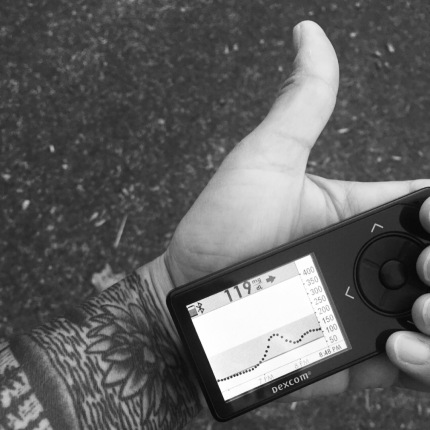
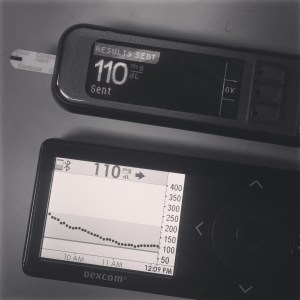
An amazing glucose reading after having a beer with friends

There are many aspects of diabetes too excruciating to wish upon your worst enemy. The finger pricks for a drop of blood large enough to satisfy the insatiable hunger of the glucometer (if you are even lucky enough to bleed when you poke), the invisible disability of hyper and hypoglycemia (we may not show it, but we can damn well feel it), the mandatory diligence required to eat a small snack of fruit (yes, there are carbs in

IMG_2288
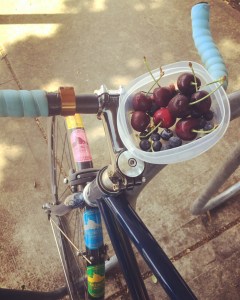
Small snack to boost glucose levels before riding

food other than junk food), and the unsolicited advice provided by well-meaning individuals who are unaware of how deeply their ignorance dwells (no, the phrase “my Aunt Gertrude had diabetes” is not relevant to a type 1 diabetic’s existence).

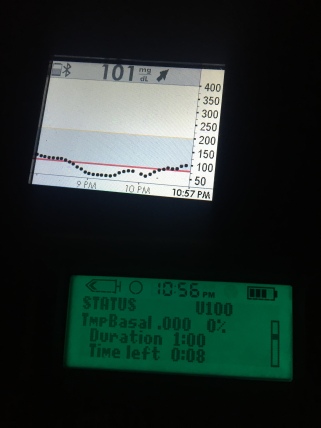
For me, one of the worst parts is the unrelenting beep, beep, beeping of the damn continuous glucose monitor during the darkness of night when every sane human in my timezone is peacefully asleep because they have a functioning pancreas. The first few beeps always get ignored. Partly, because a part of me thinks “it will go away” and the other part smartly says, “it will go away.” But it NEVER goes away… it just gets LOUDER. Rolling over and simply turning off the alert is always a possibility, but I’ve learned it WILL NOT GO AWAY if all I do is ignore it. So, I am forced, at 2:23 am, to wake up enough to turn off the alert on my cgm and to enter the damn number into my pump so it can provide me with a correction of insulin to bring me back into range–the way my pancreas is supposed to do on its own without waking me up.

Granted, there are just as many times when my cgm yells at me because I need to quickly consume some carbs and refrain from dancing on Death’s front door in my sleep. I am grateful for the lifesaving protection of my cgm. I feel naked, exposed, vulnerable and fairly helpless when I am not wearing my continuous glucose monitor. To not know the trend of my blood sugar scares me because I have experienced the trauma of being caught unaware by a tempestuous low.

But, I was not always so attached to my cgm. It actually took months before I was willingIMG_2312 to wear it continuously. At first, it was because I wanted to continue enjoying an undisturbed night of sleep. Then, there was the frustration that came from having the damn alarm scare the crap out of me with a reading of 43 only to learn I was actually at 65. They may both be scary to most people, but, for me, being in the 60s isn’t much of a concern. I have always had a high tolerance for a low blood sugar. It has saved my life on numerous occasions, so I have learned to not question, but simply to accept with joy.
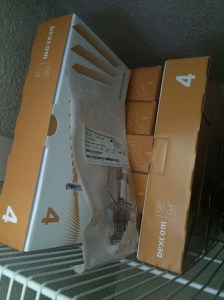
At first, my insurance company played coy and couldn’t ‘find’ the prior authorization needed to supply me with the sensors required for the continuous glucose meter to work. I spent six months calling and speaking to a new person at the insurance company. I would always ask for the name of the person trying to help me on each call and, every time I called back, none of those people were ever acknowledged to work at the company. At the time, I didn’t use the sensors with regularity because I didn’t have the hundreds of dollars I was being charged each month for a sensor that only works for seven days. I started hoarding my sensors against the day someone would stop sending them to me.

IMG_2418Finally, a day came when I looked in my closet and I saw enough boxes of sensors to make me feel secure. I felt comfortable in knowing I could wear my cgm continuously and not worry about running out of supplies. One other key revelation helped me to feel the sense of security that allowed me to let go of my need to control the amount of sensors I had on hand: I learned how to make a sensor last for longer than seven days!
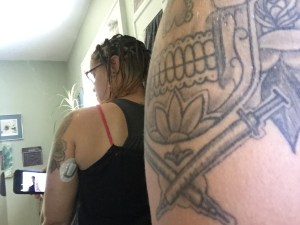
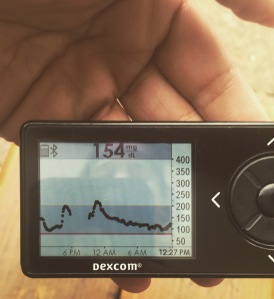
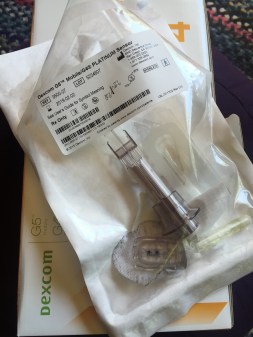
I wear a sensor for my cgm every day now. Usually, I put them on my thighs, abdomen, or above my butt cheeks, but today I put a new sensor on my arm. It’s not that I’m

IMG_2419
Tattoo celebrating my diagnosis… sugar skull with needles as crossbones

embarrassed to wear my sensor in a visible location… I’m too old to be embarrassed. I just don’t put the sensor on my arm because I have tattoos that I don’t want to cover up and that leaves very little space with which to play with. Recently, I have started connecting with other type 1 diabetics on social media and I see how proud they are to wear their cgm sensor in the open. The last time I wore my cgm sensor on my arm was shortly after first getting one, and I couldn’t get it to stay stuck on my stomach (another lesson learned: the importance of Mastisol in prepping a site).

IMG_2346
A good streak with a sensor change-simply hit ‘stop sensor,’ wait a few minutes and hit ‘start sensor’

I am no longer afraid of the insurance company denying me access to my supplies. I do not expect this truce will last forever, but I am going to enjoy the peace while I can. I don’t know how long the government will be willing, or able, to provide me with the supplies that are necessary for me to live a life of “freedom” and the “pursuit of happiness,” but I am willing to work part-time at minimum wage as a lifeguard in order to NOT make enough money to be forced to pay for my supplies. THAT, I have learned, is the full truth behind a diabetic lifestyle… sacrifice.

IMG_2416
All the waste from one sensor change

I have not only had to sacrifice my health, life expectations, life expectancy, choices in food and activities, privacy, and social perceptions caused by my disability, but I have been forced to sacrifice my ability to live a life free from the stress caused by fighting with a recalcitrant insurance company. I have willingly had to sacrifice my right to feel secure in my chances of living a safe and healthy life month-to-month.

One would think that with so many sacrifices on my mind I would be willing to do what was necessary to give myself the greatest chance of success at a long and healthy life by doing everything necessary to maintain excellent control over my diabetes. Unfortunately, there are some sacrifices I am not willing to make: the sacrifice of NO beer, of NOT eating out with friends, or of living in FEAR.

IMG_2257
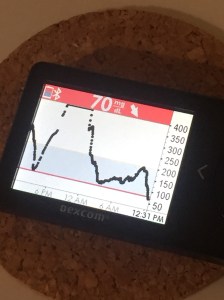
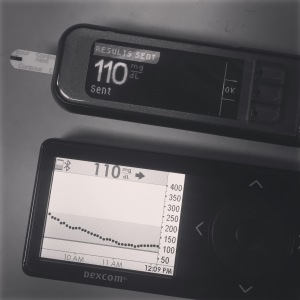
So rare, yet so exciting!

I do not know how long I will be able to rely on the State to provide me with the means to stay alive and live my life (…I am aware of how my government is not even concerned with basic Human Rights…), but I choose to continue on my path with the belief that everything will work out in the end. I have my stockade of sensors and my hard-earned knowledge of how to make each sensor last as long as possible (I think 20 days or so is my longest running streak to date). Whatever tomorrow, or next week, or even next year brings, I will be ready to continue losing sleep while wishing my damn cgm would stop beeping at me if I just ignore the damn thing.

Does it Show?


IMG_2208
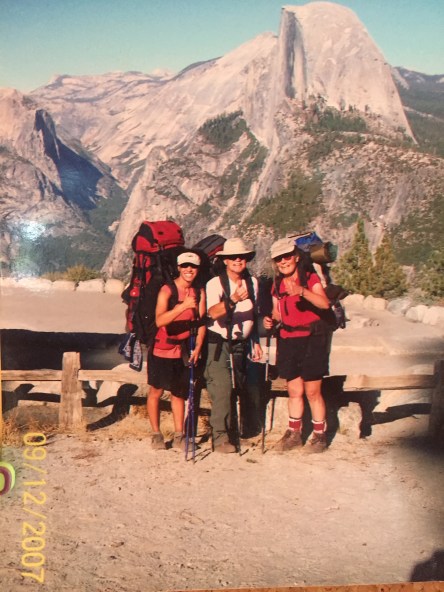
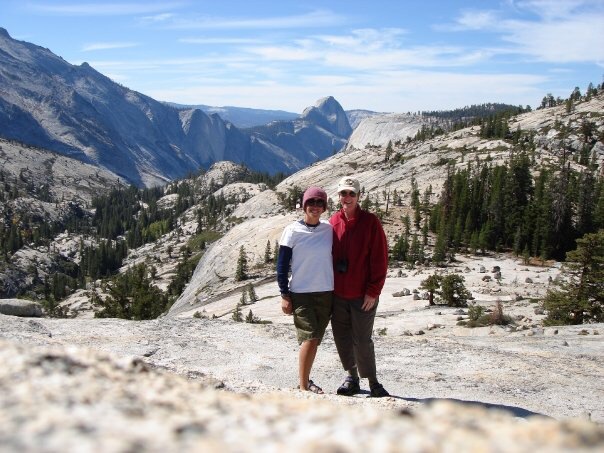
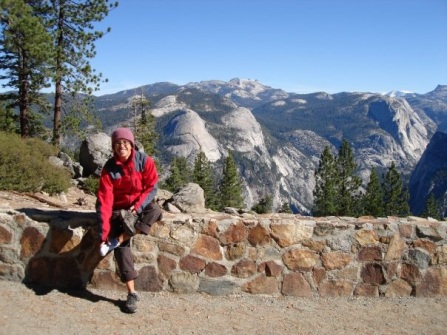
Wawona Point with Half Dome in the background

This was me (on the left) ten years ago. Before I knew my pancreas was no longer working. I look at myself now and I can see the disease. I can see how thin I was. At the time, I figured I was losing weight because I had been hiking and carrying a large pack all summer. This was the end of the season, and the couple and I had spent three days hiking to Little Yosemite Valley as a base camp for a one day summit of Half Dome. This picture was taken at Wawona Point where we had left the cars parked.

A friend (who has Lyme’s Disease, has restricted her gluten intake, and seen a drastic reduction in her body’s inflammation) said to me yesterday, “I can tell when I look at someone that they have inflammation and are swollen, just like I bet you can see if someone is diabetic.”

I love my friend. But I wanted to slap her for saying, and believing, something so incredibly stupid. Instead, I sighed and chose a response that wasn’t as snarky as my first impulse (“Yeah, right, because we all wear a bright fucking neon across our foreheads”)– I said, “I can’t tell if someone is diabetic unless I see them pull out a pancreas from their pocket.”

Simple, right? Sometimes it amazes me, and strikes me silent, when people share their

IMG_2239
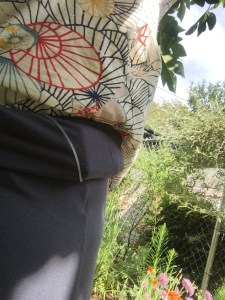
Gardening with my MedTronic

deep ignorance of diabetes. I have personally only met FIVE other people in my life who  I know are Type 1, and only two were on a pump. I randomly met the two people  on pumps at a coffee shop and a bar here in Eugene during the past two years. They both were incredibly gratifying encounters. I dated a man a few years before I was diagnosed and I knew he was Type 1, but I never saw him take a shot. In fact, I only saw him check his blood once when we were stuck in traffic on a long road trip. I knew he carried his glucometer with him (I didn’t know that was what it was called) because he carried it in an old leather cigar case he had found, and I simply knew he always had that case with him. In the six months I dated him I never learned anything more about his diabetes. It never occurred to me that it meant anything.

I forgive my friend. She has no need to understand diabetes to the depth that I am required to. Her ignorance is my fault for not asking her to become more aware and educated when talking to me about my disease. I’ve done some cursory reading on the internet about her disease, and I ask her questions, but mostly I let her rant when she feels overwhelmed by the loneliness, anger, fear, and anxiety (that I am intimately familiar with from my own experiences) which accompanies a life-altering diagnosis.

I have struggled from the very beginning to control my blood sugar levels. When I first started my diabetic journey, I would hear healthcare professionals call me “uncontrolled.” I hate, HATEHATE that label. With a passion! I was personally offended every time I heard it because the only thought I had was:

“F*CK YOU! I am doing EVERYTHING I possibly F*CKING can to control this F*CKING disease. How dare you suggest I don’t control my health!?!?!”

I have come to realize that I prefer to be labeled as “brittle” or “labile.” It is important, I think, to realize and consciously accept the labels we choose to live with. The thoughts we think, and the feelings that support those thoughts, are the reality we experience.

I am not perfect. Not even close. I just shared a post on Facebook that stated, “World’s Okayest Diabetic.” Some days I do better than other days,

IMG_2192
Usually  I try to not go so high, but it obviously happens

but every single day, without fail, I am always intensely aware of the fact that I am diabetic, and it won’t go away, and I have no choice except how I choose to take care of myself. One of the earliest lifestyle changes I made was to not tell myself I “couldn’t” eat something, but to bargain with myself instead. If there are cookies at work and I want one, I simply have to forgo that pizza I thought I would have for dinner. Some nights I will even choose to eat cookies and have pizza for dinner! My mother raised a rebel!!


IMG_2257
So rare, but so exciting!

I do work very hard to keep my numbers as close to 120 as I can. It is a struggle that I wish I could walk away from. It is a way of life that I wish I did not have to live. It is a regimen of restrictions that I resent and sometimes refuse to acknowledge. But the truth is always the same: I am diabetic. I am insulin dependent. I am disabled.

I am in the process of trying to request what I consider to be “reasonable requests for accommodation” at work based upon my disability of having  a defunct pancreas. Mostly, I am hoping to emerge from under the oppression of being rumored as a bitch at work because people in other departments don’t know I am diabetic, nor do my bosses understand the extent of which my diabetes can affect my personality when my blood sugars are fluctuating. Like I said earlier, I have always been extremely brittle. My immediate boss simply believed the rumors of what a bitch I was because he knew I was on the pump and that was supposed to “cure” my diabetes. I had no idea he thought I was “cured.”

I live a life that makes me happy. It isn’t the life I thought I would be living when I was thirty. Nor does it resemble anything like the life I thought I would be living when I was twenty. Instead, it is the life I find myself living now that I am forty. I play soccer, drink beer, camp under IMG_2209the stars, eat out with friends, ride a bike everyday, grow my garden, practice my fiddle, and learn new ways of dealing with the depression that hounds me because of the diabetes. Everyday is an opportunity to learn something new about myself. Not everyone has the chance to test their willingness to stay alive and healthy. For most people it is a default. They simply have to wake up and get dressed and make it to work. There are no life and death moments in their daily existence. They know they are alive and that they will remain alive for at least the next twenty-four hours. It is not a struggle for them. I envy those people. But, at the same time, I wouldn’t trade places with them even if it meant having a pancreas that likes me enough to do its job on its own.


New Start to an Old Life

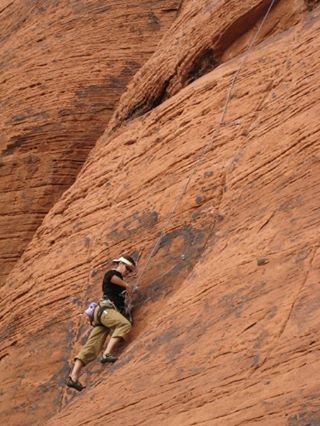
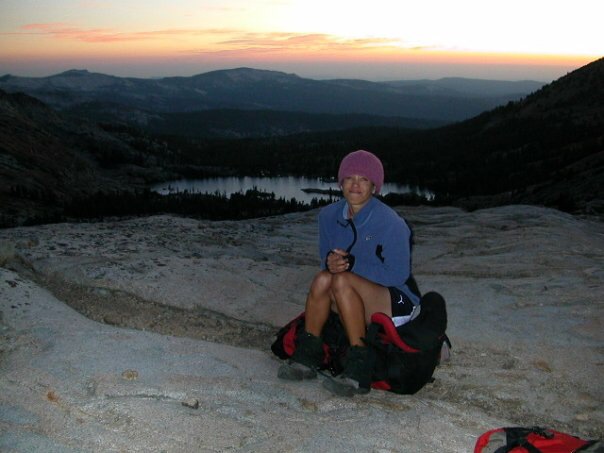
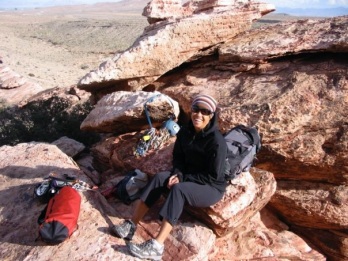
Eleven years ago, I was working as a mountain guide while living in Yosemite National Park. I led backpacking trips, as well as day trips to the summit of Half Dome, and I spent almost every day off climbing on granite. I also happened to be slowly starving to death because of uncontrolled high blood sugar levels.

IMG_0024
Taking a break on Royal Arches in Yosemite Valley

My very first A1C was 16.7% and now (as of April 2018) my A1C is 7.6%.

I was living in Las Vegas during the winter of 2007-2008 waiting for the new guiding season to begin when I was diagnosed. You would think (if you know anything about diabetes) that with an A1C as high as 16.7% that I would have been to the doctor at least once with some kind of complaint or another. But it wasn’t until my mom came to Vegas for a visit, and we went to the Bellagio for a buffet breakfast, that I finally was knocked off my feet enough to convince me to seek medical care.

I had dropped from a size 8 down to a loose-fitting size 4 by the time I was too sick to stay awake for longer than ten minutes at a time. I had simply assumed that my time spent hiking in Yosemite carrying a pack weighing around 50-60 lbs during the previous summer had been enough of a workout to accomplish the significant weight loss. I can

IMG_0007
Half Dome behind me on the right

still vividly remember the nights spent in the backcountry feeling as if there was a vast and bottomless void in my stomach. I have never felt so incredibly hungry and un-satiated after eating as I did during those few months. I would dream about food and wake up in the mornings feeling cramped from being so hungry. But, I thought, of course I’m hungry. I’ve hiked at least 8-12 miles everyday and am carrying a backpack heavier than a third grader. It’s not strange for me to be this hungry. I just have to keep eating everything I can get my hands on. Especially yummy white rice and noodles!

My winter days spent climbing and working in Vegas did nothing to help me reclaim the lost weight. My clothes were steadily becoming looser and hanging off of my hips for the first time in my life. I LOVED being thin! I remember one morning waking up at my

IMG_0008
Climbing in winter–Red Rock Canyon

boyfriend’s house after he and his roommates had left for work, eating an entire box of donuts, and not feeling the slightest bit sick–just hungry. Thinking back now, I have to wonder: how could I have felt any sicker than I already was, when I wasn’t even aware of how sick I actually was?

The intriguing uniqueness of my particular type of diabetes (Latent Autoimmune Diabetes in Adults) is that it is very slow to progress. When other Type 1 diabetics start to become sick, it is usually a swift and obvious progression of symptoms that sends them to the hospital immediately (it also usually happens in early childhood or adolescence). It wasn’t that I ignored my health. It was simply that because my health was deteriorating so slowly over the years, my symptoms became normalized without my awareness. It was normal for me to not be able to stay awake throughout an entire movie. It was so normal, in fact, that my friends were perfectly aware of the fact

IMG_0010
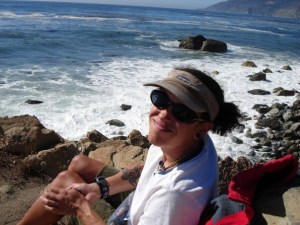
At my thinnest on the coast of Big Sur

that I would never stay awake, and it was accepted as normal by everyone I spent time with that I would eventually wind up curled on the couch or in a chair and fall asleep, even at a party. It was also normal for me to drink water continuously and not go an hour or so without having to pee.

It wasn’t until after that buffet breakfast (the last buffet I will ever attend) at the Bellagio with my mom, that my symptoms finally became obvious and severe enough to send me to Urgent Care. We had only walked a few blocks from the hotel to go shopping when I began to feel nauseous. I finally had to turn around and go back to my mom’s hotel room to rest and wait for her return. I threw up three times on the short walk back to the hotel. Once I crawled into her bed, I wasn’t able to stay awake long enough to finish watching an entire sitcom episode on the T.V. In fact, we had to turn on the television just so I was able to focus on a show and manage to stay awake for more than ten minutes at a time. We thought it was a vicious virus and we tried to manage my nausea with crackers and orange juice. Nothing stayed down, and I wasn’t staying awake.

IMG_0015
The Grand Canyon of the Tuolumne in Yosemite National Park

Finally, my mom made the decision to take me to Urgent Care (which was the first of many mistakes in my experience of being diabetic) and I learned of my condition when the doctor looked at me in disdain and contemptuously said, “you know you’re diabetic, right?”

“I do now,” was the only reply I could painfully manage.

I was immediately misdiagnosed as Type 2 because of my 32 years of age. It never occurred to the Urgent Care doctor to ask about my family history of diabetes (of which there is NONE) and I was never diagnosed as being in Diabetic Ketoacidosis (which I am now fully aware was my prognosis in hindsight, due to the two other times I have been properly diagnosed since). I was simply pumped full of two bags of saline and sent home with an appointment to begin oral treatment in a couple days.

I spent almost a month taking Metformin and some other pill that was supposed to lower my blood sugars. I read the literature explaining how to measure proper serving sizes of carbohydrates. I measured a handful of rice twice a day and ate nothing else but vegetables. Like I said, I was never one to simply ignore my health. Yet, my blood sugars

IMG_0006
Red Rock Canyon–Las Vegas, Nevada

never went below 300. Finally, the Type 2 doctor I was seeing put me on 40 units of Lantus to be taken before bed. The pharmacist at the Target I went to fulfill my prescription for the insulin, and a box of syringes, asked me if I had ever injected myself before. I looked at him in terror and mutely shook my head. Luckily, he took pity on me and took a syringe out of the box to show me how to do the impossible.

***A quick side note: to give you an idea of how much syringes petrified me, let me tell you a short story. My mom was in the Navy and just before my senior year of high school she was transferred to a small island in the Aleutian chain of Alaska. I was living with my dad at the time, but decided to live with her for the first semester of school so I could experience the great white north. Before we could leave the lower 48, however, I needed a vaccine. I remember sitting in the waiting room in the Navy hospital surrounded by mothers with young children and infants all waiting for their own vaccines. When it was my turn, and I was in the exam room, the doctor told me to relax. I was so stressed at the knowledge that I was about to be poked in the arm with a needle that I unintentionally yelled, “WHY?!?” The doctor sighed and told me I was too tense. So, I replied (loudly) “OKAY!” At seventeen years of age, I was so scared of a small needle that my shouts, from within the exam room with a closed door, had scared every child and baby in the waiting room, and they were ALL crying when I came out five minutes later.***

IMG_0014
Climbing on sandstone in Vegas

What happened the very first time I gave myself an injection of insulin now makes me smile with a feeling of carefree acceptance that has only been earned through the experience of eight and a half years of diligently injecting myself with needles at least five times a day…every day. I stood in my kitchen in Las Vegas, bare feet cold on the tile floor, and held the carefully prepared syringe in my right hand. My left hand held a pinch of skin on my belly, and I stood there looking at the syringe in my hand, waiting for the courage to stab myself on purpose. Finally, finally, I was able to jab myself in my stomach with my very first syringe and the shock of the event caused me to let go of everything and stick my hands up into the air. I chuckle every time I think of how that syringe looked sticking out of my stomach, jiggling slightly as I shook with dread from what I had just accomplished.


What I cannot smile, or chuckle about, is the memory of how I wound up that night (and

IMG_0016
Climbing on granite in Yosemite

the next four nights) crawling into the kitchen at three in the morning and sitting on that cold tile floor eating an entire box of cereal with violently shaking hands, and the same devastating hunger that had haunted me on my backpacking trips the previous summer. With the initial prescription for insulin, the Type 2 doctor had also provided me with a referral to see an endocrinologist in six weeks. After the second night of using Lantus I called the endo’s office to ask if they could fit me in sooner because, as I told the receptionist, “something is horribly wrong and I’m scared.”

I was told there was an opening that Thursday and was asked if I wanted it. I have never been so enthusiastic, or relieved, as I was at that exact moment when I answered YES!!

I remember the day of that first endocrinologist appointment being a Thursday because it also happened to be May 21, which was my 33rd birthday. I learned I would be dependent on insulin every day for the rest of my life and, as much as I hated that fact (and still do), it was also the best present the Universe could ever have given me—because the endocrinologist properly prescribed me to take FOUR units of Lantus in the evening before going to sleep. The greatest birthday gift I have ever received in my life was the opportunity to STAY ALIVE.

IMG_0025
End of a long day hiking in Yosemite National Park before being diagnosed

Needless to say, I do NOT like Urgent Care units…or Type 2 doctors.

Bikes & Brew

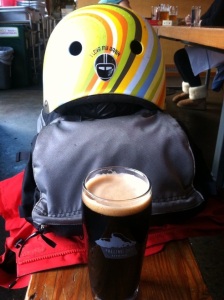
Nothing goes together in Eugene as well as bikes and beer. We are surrounded by both.

This was not the post I was expecting to share today. I stayed up late last night until after midnight working on my first “official” post, but I forgot my memory stick at home when I went across the street to eat dinner and use the wifi at the Falling Sky Deli. Oh well. The good news is that I am slowly (oh, so incredibly slowly) learning how to actually create and design my very first blog! Witness my achievement by checking out my About Me link. I must admit I am quite proud of myself.

IMG_0142
Beer & Bikes at Falling Sky

I realize none of this has much to do with diabetes, but, if it wasn’t for the fact that I am living with diabetes, this blog would not even exist. So, I guess the question is why have I  chosen to write about bikes and beer? The answer is fairly simple: I LOVE BIKES AND BEER….equally. And Eugene has an endless supply of opportunity for experiencing both…equally.

I happen to live in the Whiteaker neighborhood, which has in recent years become known for the collection of amazing breweries located in the heart of Eugene: Falling Sky, Oakshire, Hop Valley, and Ninkasi to name the best. Because I happen to live across the street from Falling Sky, I am even lucky enough to be a member of the pub’s coed indoor soccer team (soccer being my third love in life after bikes and brews).

Again, I am sure some of you (who have actually found my blog and stayed long enough to read this far) are asking: What does this have to do with diabetes?!?

I assure you the answer is nothing. Except…if my pancreas were not broken beyond repair…I would probably be riding my bike, drinking my beer, and playing my soccer games without sharing stories of such on the internet. I guess the most amazing part of living with diabetes is the fact that I haven’t allowed it the chance to stop me from riding my bike, drinking my beers, or playing an awesome game of soccer every week. Ever since my diagnosis, my biggest goal in life has been to keep BOTH my feet–no matter what it takes!

Granted, drinking beer doesn’t do much to help me succeed at keeping my feet attached to my legs, but the pedaling and running involved are certainly not deterring me from accomplishing my goal.

IMG_0145
Bikes & Beer at Viking Braggot


Eugene offers the chance to spend your days traveling on two wheels to various brew pubs around town. In the industrial section of West Eugene, one can ride to Viking Braggot (who mixes mead with their beer) and Claim 52. Near the U of O campus on the eastside of Eugene is the Elkhorn Brewery, Sam Bond’s Brewery, and McMeniman’s East 19th Cafe. Coldfire Brewery and Steelhead/McKenzie Brewery are close to the Willamette River and Spencer’s Butte, while one can also spend a long ride touring the countryside near Coburg and head out to Agrarian Ales.

We love beer in Eugene. And we love riding our bikes to go drink our beer. It’s a way of life that we have perfected into an art form. It is a lifestyle that I am proud to claim for myself. Diabetes won’t stop me from living the life I want to live. It may add a few new parameters that I may not appreciate, but in the long run I think it simply makes me more amazing. It makes me aware of the fact that everyday is special. Not because I happen to live in a community that values sustainability and hops as much as I do, but because I am ALIVE enough to realize how special everyday is. Without diabetes controlling my every moment, I wouldn’t have the awareness to realize how special my moments are.